|
The many courts of Germany and of the Habsburg Empire and its capital Vienna were open to influence from both Italy and France. It was, indeed, one of the achievements of great German composers of the late Baroque period to bring about their own synthesis of Italian, French and German. This is heard in one form in the music of Johann Sebastian Bach and in another in the music of Handel.
While Hamburg, even in Handel's brief time there, found a place for German-language opera, it was in general Italian opera that predominated. In Vienna the Emperor Joseph II attempted, principally in the 1780s, to establish a German opera, the National- Singspiel. It was to this that Mozart contributed his successful Die Entführung aus dem Serail (The Abduction from the Seraglio), but the Emperor's early attempts were unsuccessful.
Singspiel
The traditional German Singspiel had had a longer history, parallel to the popular comedy of Italy and France. As in those countries, the division between the purely popular and the more formal and literary comedy diminished. This led to a form of German- language comic opera, with some spoken dialogue, on a variety of subjects. In some, like Mozart's Die Zauberflote (The Magic Flute), elements of earlier popular comedy continue. The comic bird- catcher Papageno is one of a long line of such characters, an ordinary man set in the most extraordinary surroundings. Comedy lies, as always, in the inappropriate situation and the down- to- earth reaction to it.
Singspiel continued also in a serious vein, reflecting the parallel developments in Italy and France, as well as in German theatre, with its middle- class drama, if one may so translate the word burgerlich (bourgeois), without giving it a pejorative meaning. Beethoven's only opera, Fidelio , first staged in Vienna in 1805, deals in generally serious terms with a loyal wife's attempt to rescue her imprisoned husband. Carl Maria von Weber's work Der Freischutz (The Marksman), still in language and elements of spoken dialogue a Singspiel, includes all the elements of German romanticism and leads the way forward to full- blown German romantic opera.
Wolfgang Amadeus Mozart
This great Austrian composer was born in Salzburg on 27th January 1756.
Mozart is ranked along with Verdi and Wagner as one of the three greatest of all opera composers.
A child prodigy, his first stage work, the sacred play written at the age of 11, was Die Schuldigkeit
des Ersten Gebotes. In his three great Italian works, written in collaboration with Lorenzo da Ponte,
Mozart breaks through the rigid structures of opera, presenting music-drama of great fluidity and
remarkable human insight. His mastery of extended ensemble, his blending of serious and comic
elements; his dramatic insight and his loosening of the musico- dramatic structures all had an
incalculable influence on the subsequent development of opera.
Wolfgang was educated by his father Leopold Mozart, who was concertmaster in the court orchestra
of the archbishop of Salzburg and a celebrated violinist, composer, and author. By the age of six,
Mozart had become an accomplished performer on the clavier, violin, and organ and was highly skilled
in sight reading and improvisation. Five short piano pieces composed by Mozart when he was six
years old are still frequently played. In 1762, Leopold took Wolfgang on the first of many successful
concert tours through the courts of Europe, during this period Mozart composed sonatas for the harpsichord and violin, a symphony, an oratorio and the opera buffa La finta semplice - 1768
In 1769 at the age of 13 Mozart was appointed. concertmaster to the archbishop of Salzburg.
At the age of 14 Mozart was commissioned to write a serious opera, this work Mitridate rè ponto
produced under his direction at Milan completely established an already phenomenal reputation.
Rejection by Weber, the neglect he suffered from the aristocrats whom he courted, made the two
years from Mozart's arrival in Paris, until his return to Salzburg in 1779 one of the most difficult
periods in his life. The success of Mozart's Italian opera seria I domeneo rè di Creta commissioned
and composed in 1781, prompted the archbishop of Salzburg to invite Mozart to his palace at
Vienna, a series of court intrigues and his exploitation at the hands of the court soon forced Mozart
to leave. In a house in Vienna rented for him by friends, he hoped to sustain himself by teaching.
In 1782 Mozart married Constanze Weber, unfortunately unending poverty and
illness persistently troubled the family until Mozart's death.
Le Nozze di Figaro - 1786 and Don Giovanni - 1787, with libretti by
Lorenzo Da Ponte, while successful in Prague, were partial
failures in Vienna. From 1787 until the production of Così fan tutte - 1790
again with a libretto by Da Ponte, Mozart received no commissions for operas.
For the coronation of Emperor Leopold II in 1791 he wrote the opera seria,
La clemenza di Tito - 1791 with the libretto by Metastasio.
Mozart's large output - more than 600 works - with a number of instrumental combinations, concertos
and vocal works shows, that even as a child he possessed a thorough command of the technical
resources of musical composition as well as an original imagination. Mozart thus epitomizes the
classical style of the 18th century. His operas achieved a new unity of vocal and instrumental
writing, with their profound contrasts between different personalities reacting to changing situations.
They are marked by subtle characterization, and an unusual use of classic symphonic style in large
scale ensembles. Mozart had an unsuccessful career and died young, but he ranks as one of the
great geniuses of Western civilisation. The operas are marked by subtle characterisation, and an
unusual use of classic symphonic style in large-scale ensembles. While Mozart was working on the
singspiel The Magic Flute - 1791 an emissary of a Count Walsegg mysteriously requested a requiem
mass. This work, uncompleted at Mozart's death proved to be this great composers final work.
On December 5th - 1791 - Vienna, Mozart met his death, presumably of typhoid fever.
The legend that the Italian composer Antonio Salieri murdered him is unsupported, sadly few friends
attended his burial. Mozart's grave is left unmarked.
German Romantic Opera
Vienna brought together Italian opera and German Singspiel. Gluck and his librettist Calzabigi had brought about a reform, influenced, in some respects, by French theatre and in some works by the opera comique . Here, as in the major cities in Germany, two forms of opera co- existed, the Italian and the German. The 19 th century, however, with all its political and cultural changes, gave a new impetus to German opera, not only to Beethoven and to Weber, but to composers like Marschner, Spohr and Lortzing.
Richard Wagner
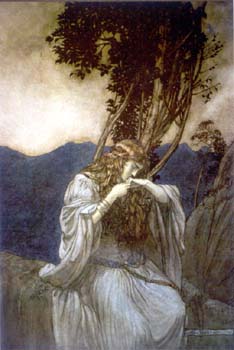
Towering over his contemporaries in ambition and achievement, Richard Wagner introduced, from the 1840s onwards, new musical and dramatic conceptions of the art of opera or music- drama. At first he added to the existing romantic tradition in Der fliegende Hollander (The Flying Dutchman), Tannhäuser and Lohengrin . The first of these tells of the ghostly Dutch sea-captain, fated to sail with his phantom crew until redeemed by a woman's disinterested love. Tannhauser turns to the medieval poet of that name and his temptation by the worldly pleasures offered by the Mount of Venus, while Lohengrin offers a story derived from the legends of the Knights of the Grail. It was, however, with his tetralogy Der Ring des Nibelungen (The Ring of the Nibelung), Parsifal , Tristan und Isolde and Die Meistersinger von Nürnberg (The Mastersingers of Nuremberg) that he created a new and comprehensive art-form. While the last of these praises true German art in a plot based on the activities of the Mastersingers of the 16 th century, The Ring is a massive conception dealing with the superhuman. The four works, to be performed on successive nights in the theatre Wagner built in Bayreuth, are closely interwoven, related by recurrent themes and fragments of themes associated with ideas and characters in the drama. The plot of this massive operatic cycle is derived from Teutonic legend, stories of the old gods and the final destruction of their Valhalla.
Operetta
Operetta seems typical of Vienna in the later 19 th century, exemplified by the work of Johann Strauss, in works such as Die Fledermaus (The Bat), with its light- hearted intrigue and attempted marital deception. The tradition of operetta found other champions in composers like Franz von Suppé, and then, leading into the new century, in Franz Lehar and his contemporaries, with parallel success in Berlin. By the 1920s, however, the formula had worn thin, gradually to be replaced by musical comedy.
After Wagner
While Wagner may overshadow his immediate successors, his influence was enormous, reflected in the operas of Humperdinck and even, however reluctantly, of the latter's pupil, Wagner's son Siegfried Wagner. The latter's operas continue to explore a German world, but rather one of Grimm's Fairy Tales than of gods and heroes. In 1893 Humperdinck won his first success with his opera Hansel und Gretel (Hansel and Gretel), following this with other fairy- tale operas. Siegfried Wagner turns to weightier German legends in a series of operas that are only now finding an audience.
Richard Strauss
The true successor of Wagner is Richard Strauss, particularly in the remarkable series of operas in which he collaborated with the writer Hugo von Hofmannsthal, after the earlier success of Salome , based on Oscar Wilde's play of that name. Wilde's work had been banned in England, and Salome as an opera suggested new realms of sensuality to be explored, both dramatically and musically. Elektra in 1909 was followed by the moving nostalgia of Der Rosenkavalier (The Knight of the Rose), a work of comedy and poignancy, an autumnal reflection of a mood of the time, set in the age of Mozart. Strauss continued after von Hofmannsthal's death in collaboration with Stefan Zweig and others. His last opera, Capriccio , was first staged in Munich in 1942. His debt to Wagner may be seen as musical rather than dramatic, reflected in orchestration and harmony.
The Weimar Republic and National Socialism
The intervention of National Socialism had, in opera as elsewhere, an immensely damaging effect on the general creativity of German opera. The 1920s had brought a period of experiment, often outrageous enough in its defiance of tradition. Composers like Franz Schreker had explored the exotic world opened by Strauss's Salome . He was dismissed from his position in Berlin and died in 1934. Other younger composers like Schoenberg, Zemlinsky, Weill, Goldschmidt and Hindemith were driven into exile and often, therefore, into other forms of musical activity. America, where some took refuge, lacked the traditions of the German opera- house. Kurt Weill, who had collaborated with Bertolt Brecht in Berlin in Die Dreigroschenoper (The Threepenny Opera), a modernised and political version of The Beggar's Opera , turned to the American musical. Schoenberg left his great opera Moses und Aron unfinished. Zemlinsky did the same, never completing his last opera. Goldschmidt in England found almost as little opportunity as Hindemith in America, both having suffered from official censorship before their forced or chosen emigration. Schoenberg's pupil Berg, however, had added his own very distinctive contribution to German opera in Wozzeck, a study of madness and murder. At the time of his death in Vienna in 1935 he left his second opera, Lulu , unfinished.
Contemporary German Opera
Germany and Austria continue to offer a fertile ground for new opera. This is encouraged by the existence of a large number of efficient provincial opera- houses and a measure of enlightened public support. There have been notable new operas from composers such as Hans Werner Henze and remarkable experiment from Karlheinz Stockhausen, among others, expanding the possibilities of music- theatre.
|






 contact
