|
Catherine built marvelous new monuments across Russia and transformed St. Petersburg into a truly European city of Imperial pretensions. The arts, music and education where patronized by her, and Catherine pumped millions of rubles into the creation of the Hermitage collection, which today is the delight of Russia and the world. No other Russian monarch appreciated beauty as much as Catherine, she set the stage for the emergence of a national Russian culture that would emerge as something unique and wonderful in the 19th century.
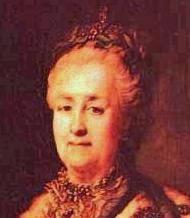 Catherine's achievements were many. She left Russia much stronger, more prosperous and beautiful than she had found it. That she failed in much she had set out to do had less to do with her and more to do with human nature. Catherine was unable to transform Russia through her will alone. Since she was unwilling to use terror or force to transform society, she chose a more patient path, hoping to gradually raise the level of culture by legislation, education, and example. She single-handedly grafted onto Russian rootstock the bud-wood of western culture, which was taken and remolded two generations later into something marvellous.
The inimitable beauty of St. Peterburg architectural ensembles and squares was extolled by many poets. The city dates its existence from May 16 (27, New Style), 1703, when the corner-stone of the Peter and Paul Fortress was laid. The city grew rapidly in accordance with a well thought-out plan. Its unique architectural monuments were created by the genius of such eminent Russian architects as Mikhail Zemtsov, Ivan Korobov and Piotr Yeropkin, and also by Western European masters - Domenico Trezzini, Bartolommeo Francesco Rastrelli, Alexandre Jean-Baptiste Le Blond, and others. The early eighteeth-century architectural ensembles were mainly constructed in the style known as the Petrine Baroque. The small buildings of the period are characterized by laconic architectural forms and festive colourfulness. In St. Petersburg the Baroque style found its fullest expression in Rastrelli's work. His Winter and Stroganov Palaces and the Smolny Convent are elegant and full of grandeur. The eighteenth-century architecture greatly influenced the shaping of the city appearence. Some of the buildings of the time are real masterpieces of world architecture.


|





 home
home 