|
BALMORAL CASTLE, Great Britain
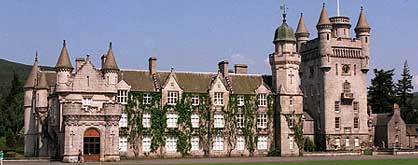
Balmoral Castle on the Balmoral Estate in Aberdeenshire, Scotland is the private residence of The Queen. Beloved by Queen Victoria and Prince Albert, Balmoral Castle has remained a favourite residence for The Queen and her family during the summer holiday period in August and September. The Castle is located on the large Balmoral Estate, a working estate which aims to protect the environment while contributing to the local economy.
The Estate grounds, gardens and the Castle Ballroom are open to visitors from mid-April to the end of July each year, under the management of the Balmoral Estate Office.
The history of Balmoral Castle starts with Queen Victoria and her husband, Prince Albert. During holiday visit to the Scottish Highlands, Queen Victoria and Prince Albert grew to love the scenery and people and decided to buy a private home there for private holiday periods.
Balmoral Castle and the original estate were purchased for Queen Victoria by Prince Albert in 1852. The original Balmoral Castle was built in the fifteenth century but it was considered too small. A new castle was constructed on the site about 90 metres (100 yards) north from the old building. Prince Albert planned the grounds and helped with the design of the castle itself, which was completed in 1856.
The castle has been handed down through their descendants, and today is the traditional holiday home for The Queen and members of her family during the summer vacation period. Over the years, improvements have been made by successive generations of the Royal family; most recently by The Duke of Edinburgh who has enlarged the flower and vegetable garden and created the water garden.
The original Estate of Balmoral consisted of 4,500 hectares (over 11,000 acres) of hill, woodland and small tenant farms. Over the years, further land was acquired, expanding the area to about 20,000 hectares (nearly 50,000 acres) at present. Farming is difficult because of the nature of the ground and the climate; 110 hectares are farmed in hand and 77 hectares are let to neighbouring farmers.
Over 3,000 hectares (nearly 7,500 acres) are planted with trees, which also provide shelter for red deer; ponies are kept for trekking and deer retrieval during the stalking season; The Queen founded the Balmoral fold of Highland Cattle in 1953; and game resources of deer, grouse and salmon fishing provide employment and earn revenue for the Estate. The Resident Factor is responsible for management of the Balmoral Estate, which employs about 60 people full-time and a further 50 to 100 part-time.
Bought in 1878 by Queen Victoria to save it from a timber merchant, the over 1,000 hectare (2,500 acre) Ballochbuie Forest now contains one of the largest remnants of native Caledonian Pine forest left in the country. Twenty-five years ago, a small area of the forest known as 'the tennis court' was enclosed in a regeneration trial suggested by The Duke of Edinburgh. In 1979, when the success of the experiment was clear, a further block of about 20 hectares (50 acres) was enclosed. This in turn showed such encouraging signs of regeneration that the enclosed area was expanded to about 300 hectares (750 acres) in 1992. The enclosed area is thoroughly monitored by the Institute for Terrestrial Ecology (ITE).
In 1974 the Estate designated the area around Loch Muick and Lochnagar as a wildlife reserve under the management of the Scottish Wildlife Trust, and built and equipped a visitors' centre to host the increasing numbers of people coming to enjoy the natural beauty of the area. The East Grampians and Lochnagar Visitor Survey carried out for Scottish National Heritage by Aberdeen University in 1995 showed that up to 180,000 hill walkers and other visitors use the open countryside and hills on and adjoining Balmoral Estate each year. The Estate maintains and restores eroded footpaths with grant assistance from Scottish National Heritage.
In 1995, 44,000 vehicles used the single-track access road which leads to the visitor centre at the Spittal of Muick. Public access must therefore be balanced against protection of the environment, particularly the habitats for which the Estate is well known (for instance an area of Lochnagar is the second-most important dotterell breeding ground in the United Kingdom).
To this end, in September 1996 the consultancy firm Environmental Resources Management (ERM) was engaged by the Lochnagar Advisor Committee - an oversight body formed by Balmoral Estate and comprising representatives of government bodies, the local community and recreational interests to address current and future visitor management issues - to undertake a visitor strategy for the Glen Muick, Lochnagar and Ballater area. The Upper Deeside Access Trust was subsequently established to implement the visitor strategy.
In 1997, the Balmoral Estate made a provisional application to the Forestry Authority to plant about 200 hectares (500 acres) of new woodland (rowan, birch, willow, scrub oak and Scots Pine) on an area of open heath hillside at Glen Gelder. Organizations including the Royal Society for the Protection of Birds and the World-Wide Fund for Nature have been invited to visit the site and an independent environmental impact assessment is now underway. The extension of native woodland is a government policy and the application has been made for environmental, not commercial, reasons.
The Estate grounds, gardens and exhibitions (including works of art and furniture from the Castle which are displayed in the Ballroom) are open to visitors, and from mid-April to the end of July each year are enjoyed by over 80,000 visitors.

|




 home
home 